Kanpur Plastipack Ltd : Microcap
-
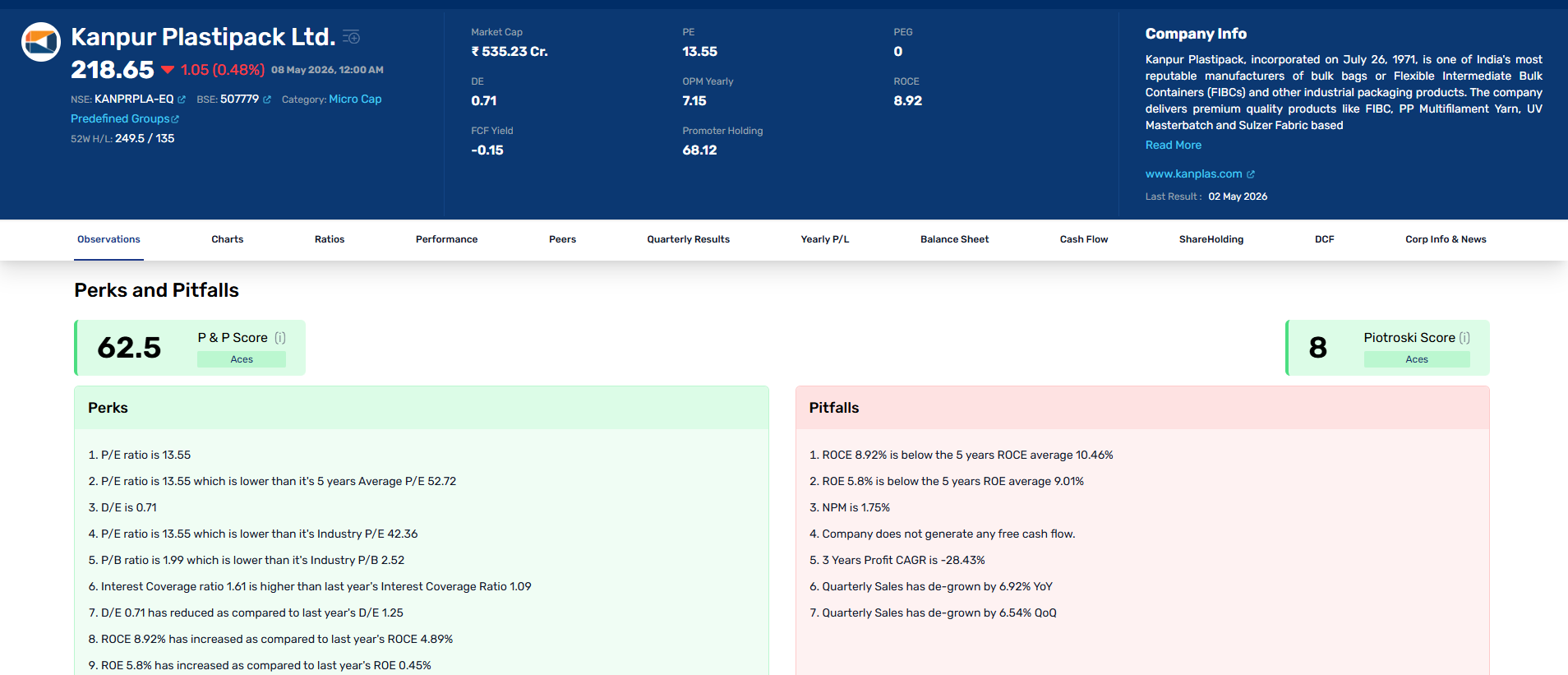
Fundamental analysis with the aid of chatgpt.
Executive Summary
The call reflects a company transitioning from a commodity packaging manufacturer into a more diversified technical-textile and value-added industrial materials player.
Key takeaways:
Core FIBC business remains stable and globally competitive.
Margin profile is structurally improving due to:
higher FIBC mix,
premium yarns,
technical textiles,
B2C/value-added initiatives.
Management appears strategically ambitious but operationally grounded.
FY27 likely to remain a transition year.
FY28 onward could see meaningful operating leverage if execution succeeds.Overall, this is evolving from a cyclical packaging exporter into a specialty industrial materials company.
What the Company Actually Does
Core business:
FIBC (Flexible Intermediate Bulk Containers / jumbo bags)
PP yarn
woven fabrics
industrial packaging exportsEmerging businesses:
Technical non-woven textiles
Premium high-performance yarns (ESSEKAN JV)
B2C/value-added packaging solutions
UK-based Valex Ventures platform
Financial Quality Assessment
FY26 Performance
Strong growth numbersManagement reported:
Revenue: ₹726.7 Cr (+26%)
EBITDA: ₹74.8 Cr
EBITDA Margin: 10.3%
PAT: ₹38.2 Cr (+68%)Q4 margins were particularly strong.
This matters because:
Raw material volatility was extremely high.
PP prices rose ~65% at peak.
Yet margins improved.That indicates:
pricing power,
disciplined procurement,
better product mix,
operational leverage.
Important Observation: Margin Expansion Looks StructuralThis is the single most important takeaway from the call.
Historically, packaging exporters often struggle to sustain margins because:
products are commoditized,
resin prices fluctuate,
competition is intense.Kanpur Plastipack is trying to escape this trap through:
- Higher FIBC conversion
Converting fabric into finished FIBC bags increases value addition.
Management explicitly said:
incremental revenue from new capacity is only ~₹40 Cr,
but EBITDA margins improve materially.Meaning:
they are prioritizing profitability over pure volume.
2. Technical textiles entryThis is potentially transformational.
Target industries:
automotive interiors,
geotextiles,
artificial leather backing,
carpets,
footwear,
filtration.This significantly expands TAM (Total Addressable Market).
More importantly:
technical textile businesses usually command better margins,
stickier customer relationships,
qualification barriers,
lower commoditization.Management guided:
FY28 non-woven revenue: ₹100–120 Cr
EBITDA margin: 15–16%If achieved, this would materially improve blended profitability.
- Premium yarn JV (ESSEKAN)
Interesting strategic move.
Key insight:
technology + patents + specialized applications.
This is important because:
commodity yarn manufacturing is easy to replicate,
specialized performance yarns are not.Management repeatedly emphasized:
difficult-to-copy technology,
IP-backed know-how,
high-margin niche positioning.That usually indicates stronger long-term economics.
Capacity Expansion Analysis
FIBC ExpansionCurrent:
18,000 TPA capacity
~83–85% utilizedExpansion:
+6,000 TPA over 4 years
This is a healthy sign because:
expansion is phased,
demand-backed,
not overly aggressive.Management avoided “hockey-stick” projections, which increases credibility.
Non-Woven Textile Business: The Biggest Optionality
This is likely the real rerating trigger if successful.
Why this matters
India’s technical textile penetration remains low versus developed economies.
The company is positioning before the demand curve steepens.
Management used phrases like:
“hyper-growth”
“industry agnostic”
“future-ready”
“backward integration possibility”These indicate:
they see this as a long-duration platform business,
not just an adjacent product line.
Competitive Advantages Emerging- Long-standing export relationships
Many customers associated for 20+ years.
This is valuable because industrial packaging purchasing is relationship-heavy.
Switching suppliers involves:
qualification risk,
reliability concerns,
regulatory standards.That creates switching costs.
- Geographic diversification
Exports:
Europe: 56.5%
South America: 21.8%
North America: 16.9%Positives:
diversified exposure,
reduced country concentration.Concern:
Europe dependence still somewhat elevated.
However, management addressed this reasonably well.
- Supply chain discipline
Management repeatedly emphasized:
“We procure largely against confirmed orders.”
This is critical in volatile commodity businesses.
It protects against:
inventory losses,
speculative resin exposure,
working capital shocks.Good sign operationally.
Management Quality Assessment
The management commentary came across as:
Positives
- Operationally knowledgeable
Responses were detailed and technically sound.
Especially on:
resin pricing,
capacity utilization,
stitching economics,
textile applications,
market segmentation.This suggests deep domain understanding.
- Conservative guidance style
Management avoided unrealistic claims.
Examples:
refused to overstate FY27 growth,
acknowledged near-term order softness,
explained inventory corrections rationally,
clarified that FY27 is partial ramp-up.This increases confidence.
- Long-term strategic thinking
The company is clearly planning:
portfolio upgrading,
manufacturing specialization,
automation,
technical capability building.This is more sophisticated than a standard packaging exporter.
Risks
- Execution risk in technical textiles
This is the biggest risk.
The business is:
new,
qualification-intensive,
customer-approval dependent.Management itself admitted:
“baby steps”
“finding our niche”
OEM approvals still pending.The opportunity is large, but execution remains unproven.
- Commodity/raw material volatility
PP prices remain a major variable.
Management expects:
new normal at $1,200–1,350/t,
not reverting to $1,000/t.Even with pass-through clauses:
working capital expands,
procurement complexity rises,
demand timing gets disrupted.
3. Europe exposureThough diversified internally, Europe remains >50% export share.
Potential risks:
recession,
energy shocks,
trade disruptions,
FX volatility.
4. Labour intensityOne very important hidden insight from the call:
“The easiest thing is to add a building and machines. The most difficult thing is to get people.”
FIBC manufacturing remains labor intensive.
Scaling skilled manpower while maintaining quality may become a bottleneck.
What Investors Should Watch Over Next 6–8 Quarters
Critical KPIs- Non-woven revenue ramp
Watch whether:
FY27 reaches ₹20–25 Cr,
FY28 approaches ₹100 Cr.This validates execution.
- EBITDA sustainability
Management guided:
~11–12% manufacturing EBITDA sustainable.
If sustained despite resin volatility, market perception may improve materially.
- Working capital
Very important in export manufacturing businesses.
Need to monitor:
receivable days,
inventory levels,
debt growth.
4. Japan market penetrationInteresting optionality.
Management sees:
first-mover advantage,
strategic positioning,
future scaling opportunity.Could become a high-quality export geography if successful.
My Interpretation of the Strategic Direction
The company appears to be moving through a deliberate 3-stage evolution:
Phase 1 (Completed)
Commodity packaging exporter.
Phase 2 (Current)
Higher-margin industrial packaging + specialty yarns.
Phase 3 (Future)
Technical textiles + engineered materials platform.
If management executes well, valuation multiples could structurally rerate because:
technical textile businesses trade at higher multiples than commodity exporters,
margins become more stable,
growth visibility improves.
Overall Fundamental View
Positives
Strong export franchise
Improving margins
Credible management commentary
Long customer relationships
Diversification underway
Technical textile optionality
Reasonable debt profile
Capital allocation appears disciplined
Concerns
New segment execution risk
Commodity/raw material volatility
Labour scaling challenges
Europe dependence
Technical textile success still unproven
Bottom-Line Analyst ViewThis does not look like a low-quality cyclical commodity exporter anymore.
Management is attempting a fairly intelligent migration toward:
specialty applications,
technical textiles,
differentiated industrial products.The key question is no longer:
“Can they grow revenue?”
The real question is:
“Can they sustainably upgrade business quality and margins?”
FY27 is likely a bridge year.
FY28–FY30 could become materially stronger if:
non-woven execution succeeds,
margins remain above 11–12%,
technical textile scale-up works.