🧱 All-Short, Multi-Leg Engineering at the Top How the 25500–25900 Zone Was Sold, Not Defended
-
🧱 All-Short, Multi-Leg Engineering at the Top
How the 25500–25900 Zone Was Sold, Not Defended
🧾 Abstract
This analysis documents a market phase where NIFTY hovered near its highs, while the entire option structure between 25500 and 25900 was constructed as an all-short, multi-leg inventory. What appeared on the index as stability was, in reality, a professionally engineered premium-selling zone, designed to suppress expansion, monetize time, and quietly prepare for repricing.
This was not selective hedging.
This was deliberate, layered short positioning across strikes.
1️⃣ The First Critical Truth: This Was an ALL-Short Structure
Let us remove ambiguity at the outset:
 Every visible leg in the 25500–25900 band was short.
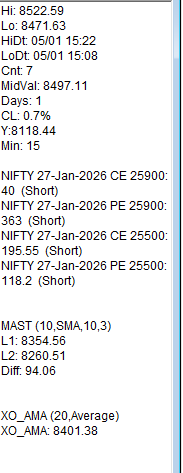
The right-hand inventory panel confirms:
- Multiple Call strikes shorted simultaneously
- No dominant long call exposure
- No aggressive upside hedge
- Inventory spread intentionally, not reactively
This immediately invalidates any bullish interpretation.
This was not “resistance forming.”
This was resistance being sold. 🧾
2️⃣ Why a Single-Strike View Completely Misses the Point
Looking at only one strike (e.g., 25500 CE) creates a false narrative:
- “This call failed”
- “That strike rejected price”
In reality:
- The entire range was pre-sold
- Each strike acted as a layer, not a bet
- Risk was distributed horizontally, not vertically
 Professionals do not guess direction.
They define boundaries.
3️⃣ The 25500–25900 Band: A Monetization Corridor
This zone was not random. It was a designed operating corridor.
Evidence:
- Repeated price rotation inside the band

- Horizontal option resistance holding over time

- Premium continuously harvested across legs

- Zero urgency to push price higher

In an all-short structure:
- Price must not expand
- Volatility must stay contained
- Time must do the work
Key insight:
🧠 When an entire range is shorted, the goal is not accuracy — it is inevitability.
4️⃣ Why the Index Still Looked “Strong” (and That Was the Trap)
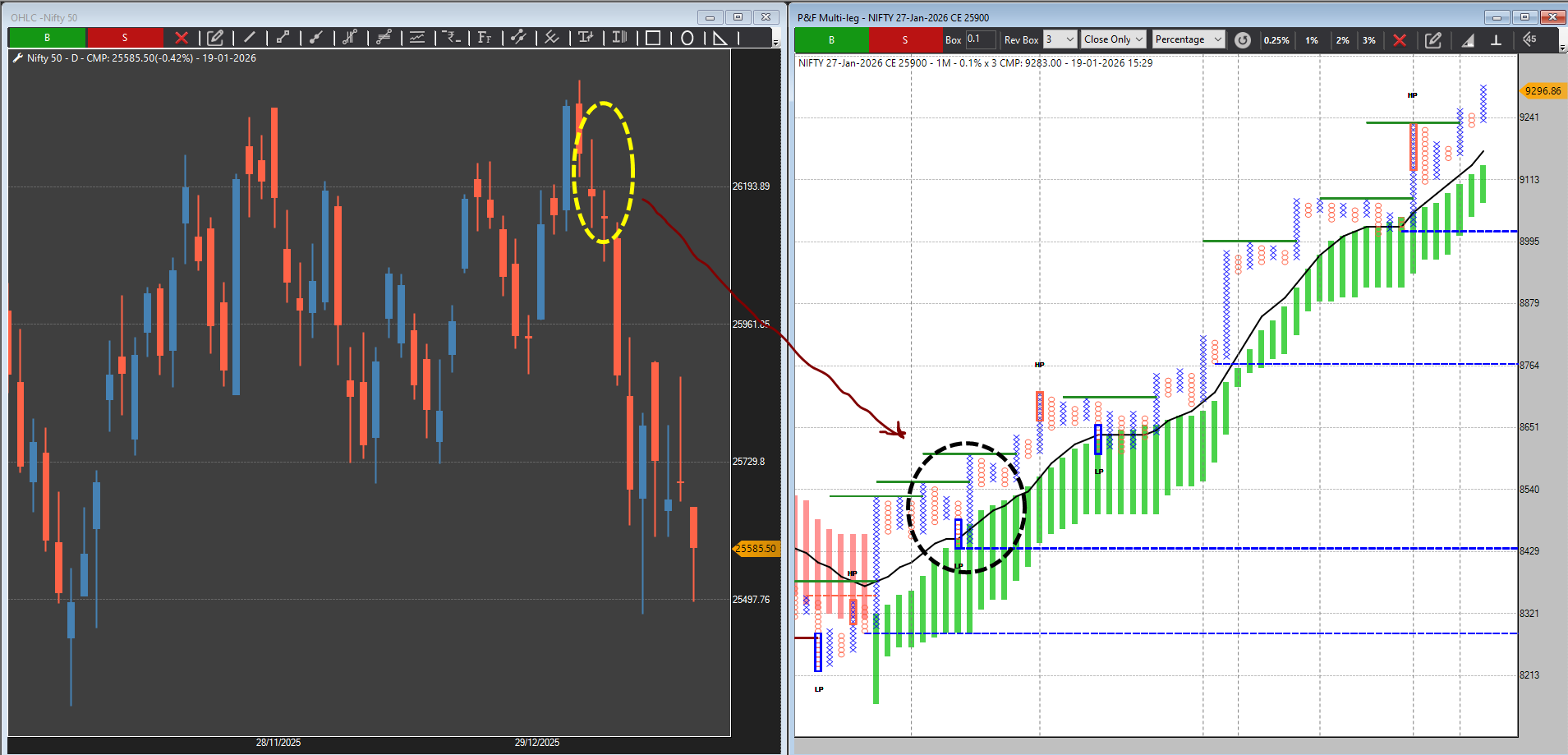
On the NIFTY daily chart:
- Overlapping candles
 ️
️ - No immediate breakdown
- Minor higher highs still printing
This visual calm is intentional.
Meanwhile, the option structure was doing the opposite:
- Every rally sold into 🪜
- Every pause monetized
- Every hour benefiting sellers

Buyers paid for hope.
Sellers were paid for time.Key insight:
 ️ When price looks calm at the top, it is often because professionals have already neutralized upside risk.
5️⃣ Multi-Leg Shorting = Control, Not Opinion
Single-leg shorts can be trades.
Multi-leg shorts are policy.Your chart shows:
- Confidence (no panic hedging)

- Layered resistance at multiple strikes 🧱
- Smooth inventory management
 ️
️
This tells us:
- Institutions were not reacting
- They were executing a plan
- Direction was postponed, not uncertain
Key insight:
 When many strikes are short, price is being managed, not discovered.
6️⃣ The Most Lethal Market Condition: Range at the Top
An all-short range near highs is the most damaging environment for traders:
- Bulls feel safe because price isn’t falling

- Bears stay inactive waiting for breakdown

- Vol sellers collect steadily
- Directional traders bleed slowly 🩸
This phase exists to:
- Drain late enthusiasm

- Transfer risk invisibly 🤫
- Normalize the idea that “nothing is happening”
Key insight:
🧊 Tops are not violent. They are boring — by design.
7️⃣ Why the Breakdown Always Feels “Out of Nowhere”
When price finally leaves such a zone:
- Traders say “sudden move”

- But structure decided long before
The option market had already:
- Sold the ceiling 🧱
- Neutralized upside
- Earned time decay
- Positioned for asymmetry
 ️
️
Price simply followed authorization.
Key insight:
🧬 Structure decides. Price executes.
8️⃣ Non-Negotiable Lessons from This Episode
- If all legs are short, direction is capped

- Zones matter more than strikes
 ️
️ - Time decay is an active weapon
- Sideways near highs = distribution
- Calm price does not mean neutral intent ️
🧠 Final Thought
This was not a failed call,
not a confused market,
and not indecision.This was a professionally sold range, executed through all-short, multi-leg option inventory, while the index maintained the illusion of strength
 .
.The real shift in thinking is this:
 The market is most dangerous when it looks controlled, quiet, and reasonable.
Those who understand this stop asking
“Will it break?”
and start asking
“Who is being paid while it doesn’t?”That question marks the line between retail interpretation and structural understanding.
-