
Can a fund's price lie? What Turkey's frozen funds teach Indian investors
-
Can a fund's price lie? What Turkey's frozen funds teach Indian investors
On 17 September 2026, Turkey's market regulator froze 131 mutual funds in one go. About 4.5L investors had money in them, worth roughly $20 billion -close to ₹2 lakh crore. Investors will get their money back only after two large banks sell the assets held by these funds. The regulator has said this process could take up to six months.
Most of us are probably never going to invest in a Turkish mutual fund. But I still think this story is worth understanding. Because what happened there teaches us something very basic about investing:
The price you see on the screen may not always be the price at which you can actually sell.
And this can happen in any market, including India.
What happened
Turkey has been struggling with very high inflation. Prices there have risen by around 50% a year on average over the last three years. Naturally, investors were looking for investments that could beat inflation. A few fund houses seemed to offer exactly that. Their biggest fund went up by more than 15,000% in less than two years.
That itself should make us curious. How does a fund generate that kind of return?
Many of these funds were buying shares of small companies where very little trading was happening. This creates an interesting problem. Suppose you are one of the biggest buyers in a small stock. Your own buying starts pushing the share price higher. The higher share price increases the NAV of your fund. The rising NAV attracts more investors. That brings more money into the fund. The fund then uses this fresh money to buy more of the same shares. And the cycle continues.
Indian investors will immediately understand this. In our market language, you could say the funds were effectively becoming operators in their own stocks. We have seen similar behaviour before. In 1992, Harshad Mehta used money routed from the banking system to push up shares such as ACC. Once Sucheta Dalal exposed the money trail in April 1992, the whole structure started falling apart.
In Turkey, according to Bloomberg report, the problem went even further. Some supposedly “safe” money-market funds — similar to our liquid funds — were also lending money against these inflated shares.
Then came the problem. In late August, the regulator told the funds to reduce some of their biggest holdings by December. But selling large quantities of illiquid shares is not easy. The moment you start selling, the price can fall sharply. Investors understood this and rushed to withdraw their money. Within three weeks, two fund houses were unable to meet redemptions.
The regulator eventually froze the funds.
A simple way to understand it
Anyone who has held a small-cap or microcap stock during a bad market will understand this situation. Your screen may show that the stock is trading at ₹100. But the stock is locked in lower circuit. There may be lakhs of shares waiting to be sold and almost no buyers. So is ₹100 really the price? Technically, yes. But practically, you cannot sell at that price.
That is the difference between market price and real liquidity.
Now imagine the same situation inside a mutual fund. The fund owns crores of rupees worth of such shares. At the same time, lakhs of investors ask for their money back. The fund now has to sell those shares. But who will buy them? That gap between the value shown on paper and the value you can actually realise in the market is where the real problem starts.
Was this one fund house or the whole Turkish mutual fund industry?
This was one question I wanted to understand. Most news reports did not clearly explain it, so I checked the data. The 131 frozen funds belonged to seven fund houses Interestingly, none of these seven fund houses was owned by a bank. Just before the crisis, these funds represented around 12.6% of the total Turkish mutual fund industry. One fund house, Tera, accounted for almost half of that amount. The large bank-owned fund houses were not part of the freeze. So this was not a collapse of the entire Turkish mutual fund industry. It was mainly a problem in one part of the industry.
However, fear did spread. Other independent fund houses that were not frozen also saw one of their worst three-week periods of withdrawals since the beginning of 2025. That is also normal behaviour in financial markets. When investors suddenly lose confidence in one part of the system, they often start questioning everything else as well.
Indian investors may remember what happened with Franklin Templeton in 2020. In April 2020, Franklin Templeton shut six debt schemes holding around ₹25,215 crore because the bonds could not be sold quickly during the Covid panic. But there was an important difference. Those bonds were real assets. The problem was that selling them required time. By August 2023, investors had received around ₹27,508 crore — roughly 109% of the value of the schemes when they were closed.
The Turkish situation is more complicated. If the funds themselves helped push the share prices higher through their own buying, then nobody really knows what those shares will fetch when large quantities are finally sold.
What the data shows
I downloaded the daily data for Turkish funds from TEFAS, the official platform where these funds are bought and sold.
Three things stood out.
1. A large part of the growth came from rising asset prices
Over three years, the frozen funds became around 74 times bigger. At first glance, we may think huge amounts of new investor money entered these funds. But that was only part of the story. Fresh investor money explains around 43% of the increase. The remaining 57% came from the value of the shares held by these funds going up. And remember, the funds themselves were major buyers of many of these shares.
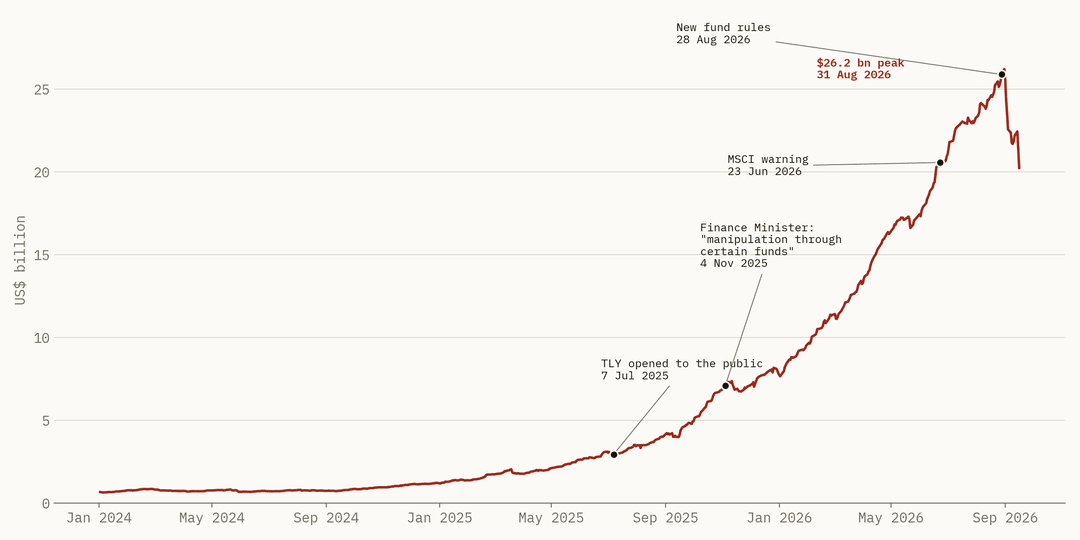
Combined size of the 131 frozen funds in US dollars, January 2024 to 16 September 2026, with the public warnings marked. Source: TEFAS (Takasbank) daily fund data, my calculation.2. Investors ignored the warnings
In November 2025, Turkey’s Finance Minister publicly said that manipulation was happening through certain funds. You would think investors would become cautious after such a warning. The opposite happened. The number of investor accounts in these funds increased from around 1.8 lakh to 6.4 lakh. August 2026 — the same month when new rules were announced — saw the highest number of new accounts. This is something we often see in markets. When returns are very high, warnings start looking less important. Everyone assumes they will exit before everyone else. Usually, not everyone can.
3. The “safe” funds were giving unusually high returns
This part is especially interesting. A money-market fund is supposed to behave somewhat like a savings account. It normally lends money for short periods to banks, government institutions and other relatively safe borrowers. Funds in the same category therefore usually earn similar returns. For the year ended August 2026, normal Turkish money-market funds returned around 46%. The frozen funds returned around 53%. And Tera’s TP2 fund returned around 60%.
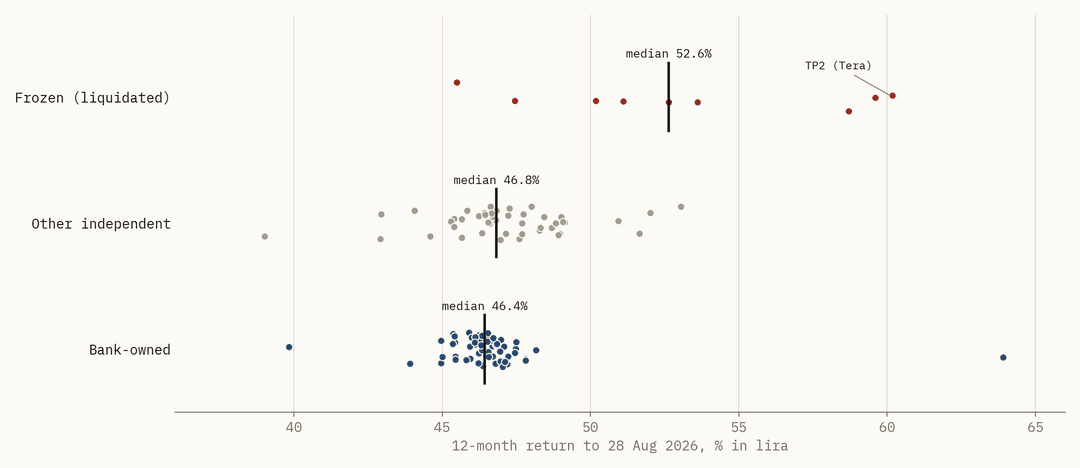
12-month return of Turkish money-market funds to 28-Aug-2026, in lira. One dot per fund; the black line is the median of each group. Source: TEFAS (Takasbank) daily fund data, my calculation.Think about it in Indian terms. Suppose almost every liquid fund gives around 7% in a year. Then suddenly one liquid fund gives 9%. Where did that extra 2% come from? It cannot come from exactly the same safe investments held by everyone else. The fund must be doing something different. And that “something different” normally means additional risk.
In Turkey, the difference was not 1% or 2%. It was around 6 to 14%. That was a major clue that these funds were taking very different risks compared with normal money-market funds.
A simple example
Let us take an imaginary fund. Suppose the fund owns ₹100 crore worth of shares in a small company. But only around ₹50 lakh worth of that company's shares trade every day. The fund obviously cannot dump ₹100 crore into the market in one day. Suppose it can sell around 20% of the normal daily volume without badly affecting the price. That means it can sell only around ₹10 lakh per day. At that speed, selling ₹100 crore would take around 1,000 trading days. That is roughly four years. Of course, this is only an illustration. But it explains the problem. On the fund statement, the holding may be worth ₹100 crore. But if you cannot actually sell it anywhere close to ₹100 crore, what is its real value?
That is liquidity risk.
We have recently seen another version of this problem in India
Indian investors saw a smaller example recently, although the reason was completely different. Motilal Oswal’s Nasdaq Q 50 ETF — MONQ50 — invests in US stocks. Between 4 September and 18 September, its NAV hardly moved. It went from ₹118.74 to ₹118.14. But its market price went from ₹141.93 to ₹396.30. Think about that. Investors were paying more than ₹3 for every ₹1 worth of shares actually held by the ETF. Why?
There was a shortage of ETF units. India has limits on how much mutual funds can invest overseas. Because of these limits, the fund could not freely create new ETF units to meet the demand. So demand kept increasing while supply remained restricted. The ETF's market price moved far above its actual NAV. Then the situation reversed. The ETF hit its 20% lower circuit on 21 September and again on 22 September. It closed at ₹253.64 — still more than double the value of the assets inside the ETF. The fund house asked investors to check the iNAV, which shows the live value of the ETF’s underlying holdings, and to use limit orders while buying. The reason was different from Turkey.
But the lesson was the same: The price on your screen and the actual value of what you own are not always the same thing.
And then there are microcaps
The Turkish situation depended heavily on shares with very low liquidity. In India, that risk is most visible in the microcap segment — broadly, companies below the top 500 by market capitalisation. Many microcap companies are perfectly good businesses. There is nothing wrong with investing in them. But liquidity works both ways. Buying may be easy when everybody is excited. Selling can become very difficult when everybody wants to exit together.
A few recent numbers are worth looking at. In the month ending 1 October 2026, the Nifty Microcap 250 index was roughly flat. Looking only at the index, you might think nothing much happened. But inside the index, 48 stocks fell more than 10%. Ten stocks fell between 15% and 32%, according to the Economic Times. An index has 250 stocks. An investor may own only five. So the index can look completely normal while someone's personal portfolio looks very different.
Microcap corrections can also be severe. The Nifty Microcap 250 fell around 82% between January 2008 and March 2009. The Nifty 50's worst fall during the same crash was around 60%. The Microcap 250 also fell around 71% from January 2018 to March 2020. Even during the much smaller correction ending in March 2025, it fell around 27% from its peak, compared with around 16% for the Nifty 50. NSE launched the index only in May 2021, so the older numbers are based on back-calculated index history.
There is one more interesting example. Motilal Oswal's Nifty Microcap 250 Index Fund stopped accepting new investments from 8 January 2026. Existing SIPs were also paused. The fund house said this was done “in consultation with SEBI as microcap is not defined as category based on market capitalization.” This was a regulatory issue, not a problem with the underlying companies. Still, it reminds us that this part of the market is relatively new and still evolving. Nobody knows exactly when liquidity will disappear. And nobody knows how far a thinly traded stock can fall once buyers step away.
Depending on your own risk tolerance and portfolio allocation, it may make sense to keep microcaps as a smaller part of the portfolio, diversify across several companies or use a fund. Most importantly, do not judge an investment only by last year's return. A stock giving 60% return looks wonderful on your screen. But if hardly anybody trades that stock, part of that return remains only on paper until someone is willing to buy it from you.
Four simple checks before investing in any fund
1. Look at what the fund owns, not only at its return
Check the fund's monthly factsheet. Look at the top holdings. If a large part of the portfolio is invested in small companies that you have never heard of, ask a simple question: If the fund had to sell these shares tomorrow, how easily could it do so?
2. Compare a “safe” fund with other funds in the same category
If most liquid or money-market funds are giving similar returns but one fund is giving significantly more, do not immediately assume it is a better fund. Ask where the extra return is coming from. Higher returns normally require taking some additional risk. Your job is to understand what that risk is.
3. Check whether the fund owns companies connected to its own group
If a fund's major holdings include companies connected to the fund house, its promoters or related entities, understand why. Read the factsheet and scheme documents. Related-party holdings do not automatically mean something is wrong. But they deserve additional attention.
4. Do not treat regulatory approval as a guarantee
One Turkish investor told Bloomberg:
“These were all regulator-approved funds.”
That is an important point. A regulator can create rules, disclosures and safeguards. But regulatory approval does not mean an investment cannot lose money. It also does not remove our responsibility as investors to understand what we are buying.
Should Indian mutual fund investors worry?
There is an important difference between Turkey and India. Indian mutual funds operate under tighter diversification rules. For example, SEBI does not allow a normal mutual fund scheme to invest more than 10% of its assets in shares of one company. Hedge-fund-style products in India, such as Category III AIFs, also have a minimum investment requirement of ₹1 crore. So for an ordinary Indian SIP investor investing in diversified mutual funds, the risk of something exactly like the Turkish episode is much lower. But the broader lesson is still useful.
Whenever returns look unusually good, ask: What risk am I taking to earn this return?
Whenever you invest in something illiquid, ask: If I want to exit tomorrow, who will buy it from me?
And whenever market price moves far away from underlying value, ask: Am I buying an asset, or am I buying somebody else's excitement?
NISM's investor guide gives perhaps the simplest advice:
“If you do not understand or are not sure, do not invest in a hurry.”
SEBI says something similar in Hindi:
Jagruk Niveshak, Surakshit Niveshak. | An alert investor is a safer investor.
Sometimes the best investment decision is not finding the next big winner. It is simply understanding what you own.
Happy to answer questions below.
Educational research based on publicly available information. This is not a recommendation to buy or sell any security. Investigations in Turkey are ongoing and nobody has been convicted yet. Fund data is from TEFAS (Takasbank), which does not guarantee its accuracy.Investment in securities market are subject to market risks, read all the related documents carefully before investing.
-
Very well explained

 Weekly Relative Strength Ranking Report