What does the evidence suggest about the sequence?
-
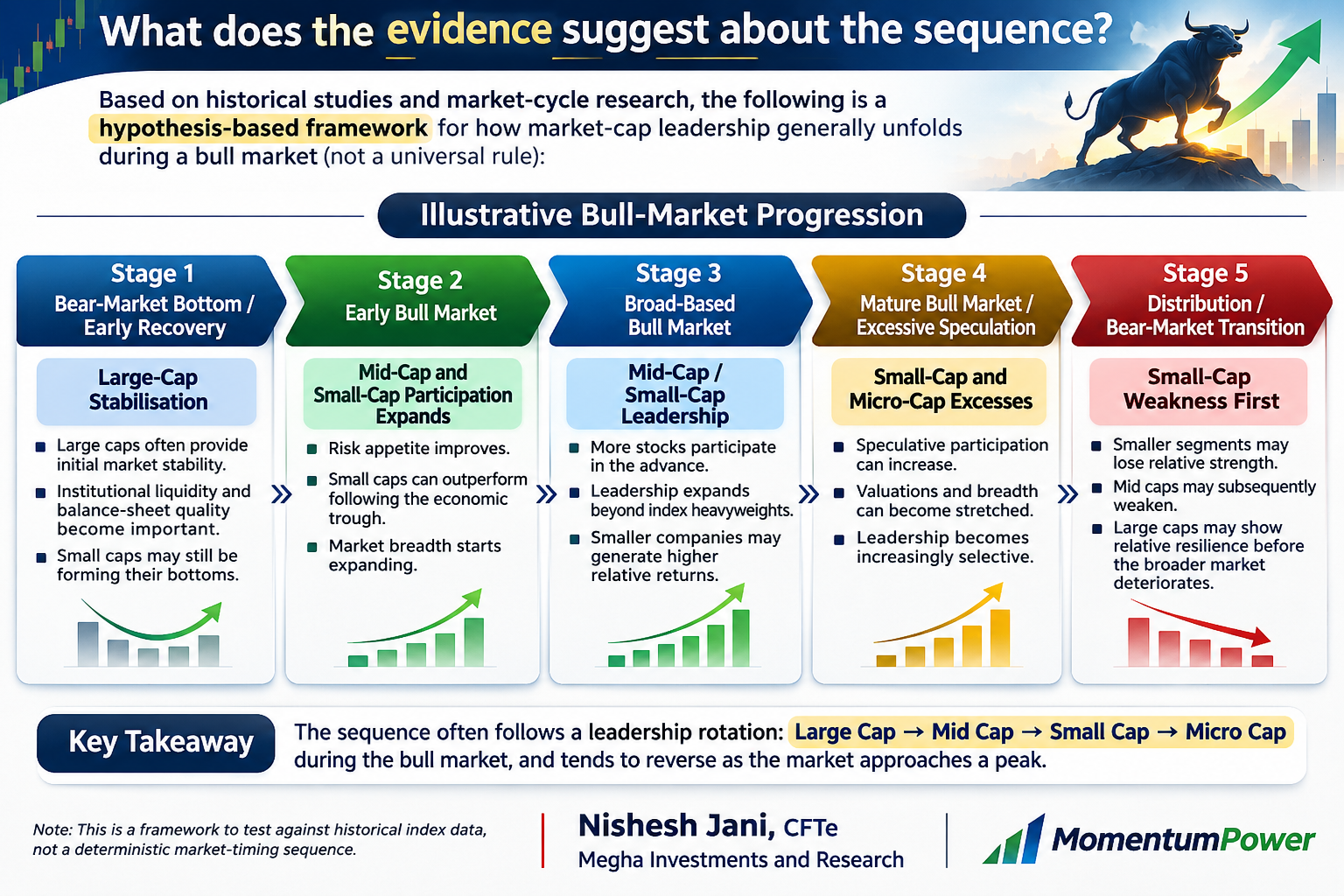
What does the evidence suggest about the sequence?
The following is a hypothesis-based framework, not a universal rule.
Illustrative bull-market progression
- Stage 1 – Bear-market bottom / Early recovery
Large-cap stabilisation
- Large caps often provide initial market stability.
- Institutional liquidity and balance-sheet quality become important.
- Small caps may still be forming their bottoms.
- Stage 2 – Early bull market
Mid-cap and small-cap participation expands
- Risk appetite improves.
- Small caps can outperform following the economic trough.
- Market breadth starts expanding.
- Stage 3 – Broad-based bull market
Mid-cap / Small-cap leadership
- More stocks participate in the advance.
- Leadership expands beyond index heavyweights.
- Smaller companies may generate higher relative returns.
- Stage 4 – Mature bull market / Excessive speculation
Small-cap and micro-cap excesses
- Speculative participation can increase.
- Valuations and breadth can become stretched.
- Leadership becomes increasingly selective.
- Stage 5 – Distribution / Bear-market transition
Small-cap weakness first
- Smaller segments may lose relative strength.
- Mid caps may subsequently weaken.
- Large caps may show relative resilience before the broader market deteriorates.
This is a framework to test against historical index data, not a deterministic market-timing sequence.
#largecaps #midcaps #smallcaps #microcaps #bullmarket #rotation

 JUST 4 DAYS TO GO FOR MANTHAN KOLKATA!