"Sold out" in the US and still falling: what's going on with Silver and what it tells Indian investors
-
Last week a post on X went round the bullion world. It said silver grain, the small pellets that mints melt into coins, had "vanished" in the US until the new year. It credited the line to the CEO of Scottsdale Mint, one of America's well-known private mints.
In the same week, silver futures in New York fell 16%, and 7.4% on Friday alone. Back home, Nippon India Silver ETF (SILVERBEES) closed at ₹146.78 on 20 November, down from ₹211.85 on 5 October. MCX December silver dipped below ₹1.5 lakh a kg during Friday's trade.
Most of us are never going to import silver grain from an American refiner. Still, I think this story is worth understanding, especially since lakhs of Indian investors now hold silver through ETFs and fund of funds. In October alone, Indians put a net ₹3,092 crore into silver ETFs, according to AMFI data, while the price was falling.
What is happening right now teaches us something very basic about commodities:
The price you see on the screen is decided in the paper market, not at the physical shop in Zaveri Bazaar.
And during moments of market stress, those two worlds can move in completely opposite directions.
First, what actually ran out?
I got curious about this 'silver grain out of stock in US' news and went looking for the source.
SilverTrade, a bullion dealer, quoted Josh Phair, who runs Scottsdale Mint, as saying silver grain would be hard to get until the new year. The same post said large 1,000-ounce bars were readily available to foundries. Grain is the small silver pellets some manufacturers need. If your production line needs pellets on Monday, the offer of a large bar leaves you with some work to do. Phair’s November comments · Scottsdale Mint on refinery delays
So what ran short was refining capacity, not the metal. Big industrial users and bullion banks deal in large 1,000-ounce bars, and those are still sitting in vaults. Mints, jewellers and smaller manufacturers need grain. Turning bars into grain takes refinery time, and that queue is months long.
Fair enough for an American manufacturer. But in basic economics, something which is on a waiting list should get costly. Instead the price fell sharply... That itself should make us curious, what really happened and what has any of this got to do with the price of the kilo sitting in your locker or ETF in India?
Silver's crash did not start last week!
Let's have a look at silver's price since January 2025.
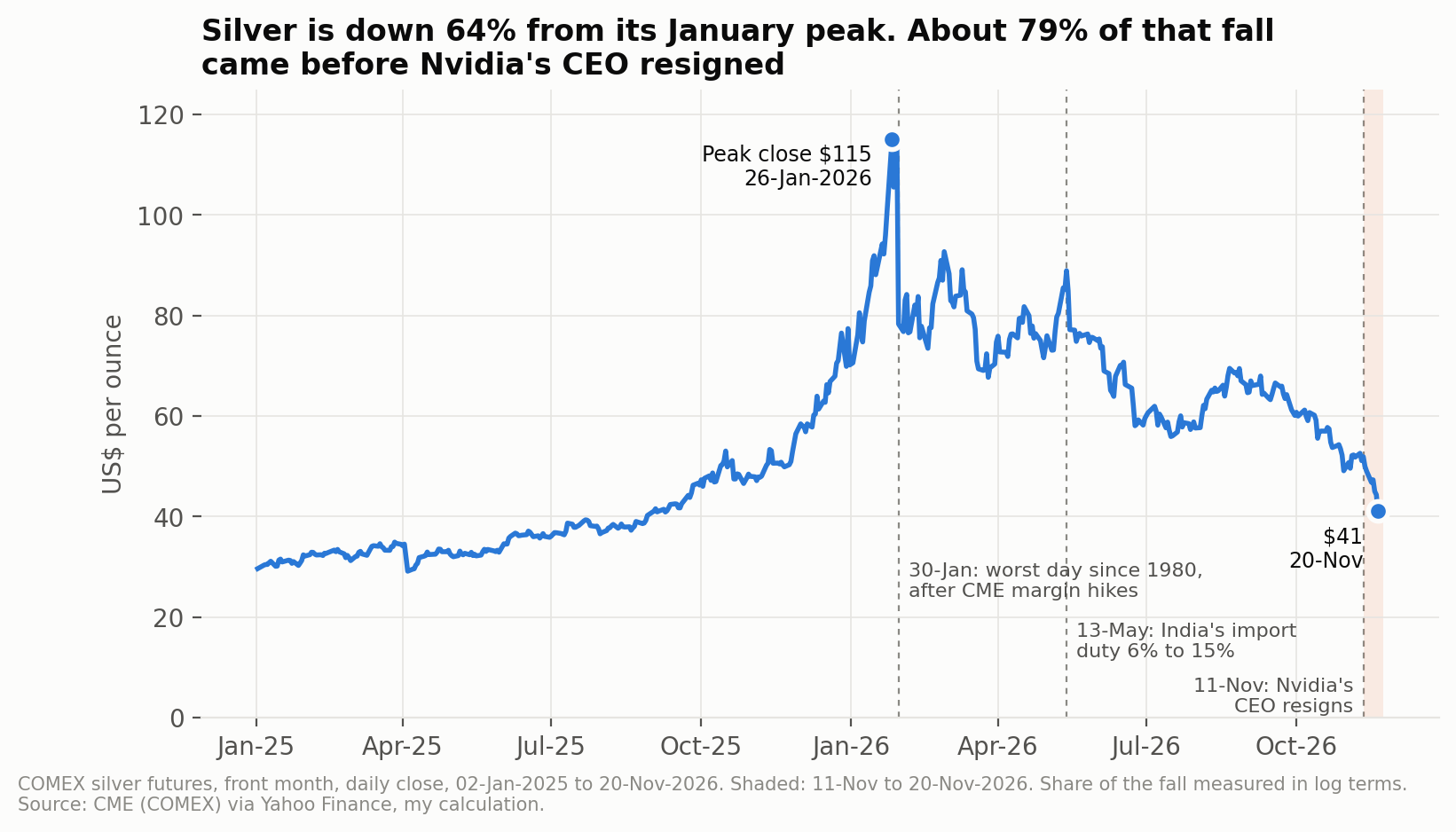
COMEX silver futures, front month, daily close, 02-Jan-2025 to 20-Nov-2026. Source: CME (COMEX) via Yahoo Finance, my calculation.Silver closed at $115 an ounce on 26 January 2026, almost four times its price at the start of 2025. Four days later it had its worst day since 1980, after the US exchange CME raised the margin that futures traders must keep. On Friday it closed at $41, 64% below that peak.
About 80% of the fall had already happened before 11 November. So last week was the last leg of a ten-month slide.
For Indian investors the fall was a little smaller. SILVERBEES is down 58% from its own January peak, because the rupee weakened and India raised its import duty in May (more on that below). Even so, SILVERBEES is back where it was in November 2025. A full year of gains is gone.
Why did paper traders dump silver last week and what it has got do with Nvidia?
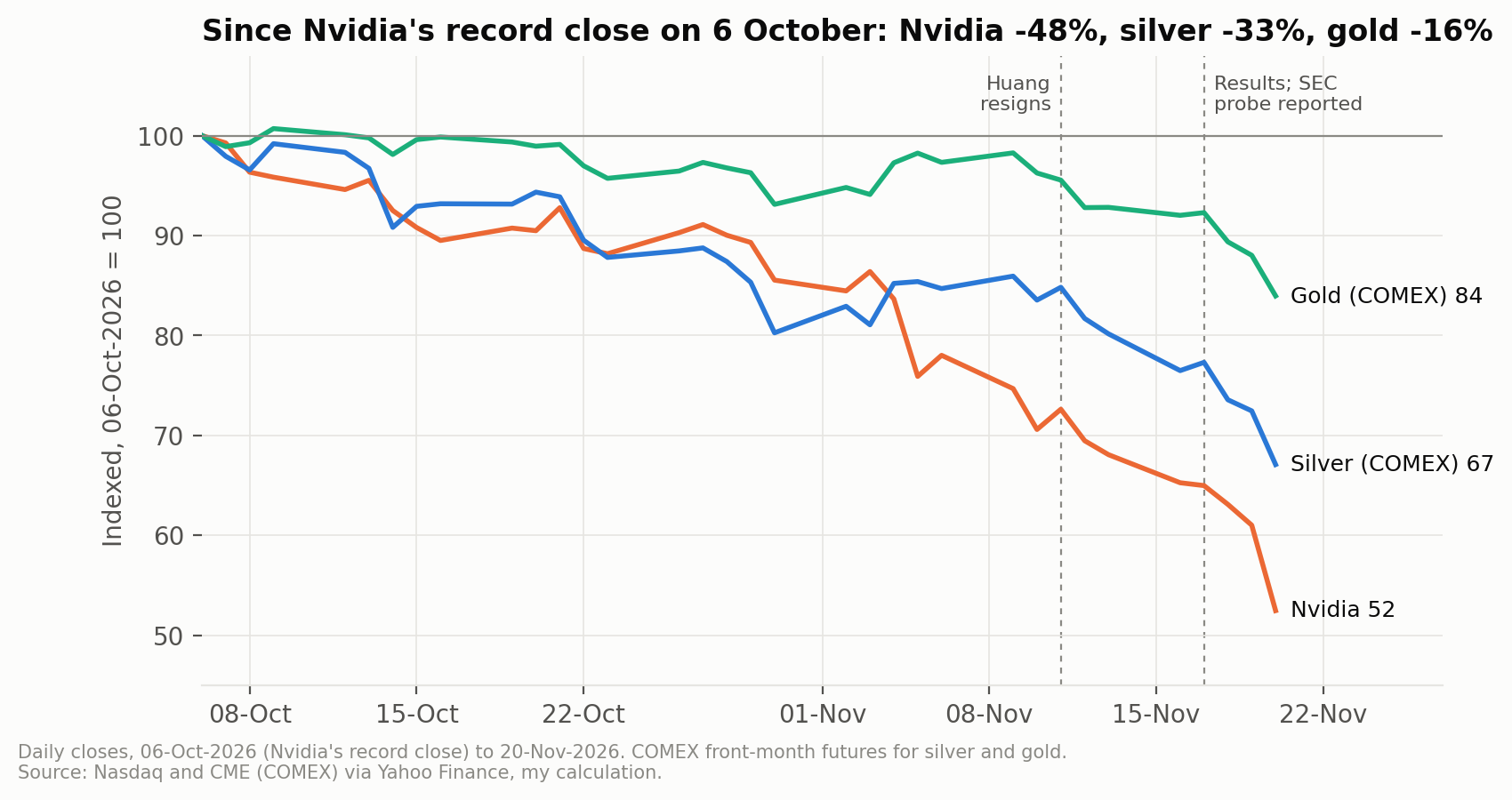
On 11 November, Nvidia's board accepted the resignation of its founder and CEO Jensen Huang, after a personal scandal with reported China links. On 17 November Nvidia reported record quarterly revenue of $115.8 billion. The same day, the Wall Street Journal reported that the US market regulator (SEC) was opening a probe into whether Nvidia's disclosures misled investors. On Friday the stock fell 14% in a single day, and it is now 48% below its record close of 6 October.
Nvidia was the biggest pillar holding up the US market, so the fall spread across AI and technology shares.
Daily closes, 06-Oct-2026 to 20-Nov-2026, indexed to 100. COMEX front-month futures for silver and gold. Source: Nasdaq and CME (COMEX) via Yahoo Finance, my calculation.Indian traders who have watched a sudden market crash will immediately understand what happens next.
As an options trader, the part I understand best is the margin call. Say I’ve taken a loss in one position and my broker wants more margin by the afternoon. I may square off a perfectly good second position because that’s where I can free up money. On a bigger scale, a fund holding tech shares and silver futures can face the same choice. Often you sell whatever is liquid, and silver futures trade almost round the clock in large size.
Friday's numbers fit this scenario. Silver usually falls when the US dollar and US bond yields rise. On Friday the 10-year US bond yield fell from 5.05% to 4.91%, and the dollar index slipped a little. Both should have helped silver. Silver still fell 7.4% and gold 4.6%, on the day Nvidia lost 14%. That looks like selling to raise cash.
Silver has also moved with Nvidia far more than it used to. The correlation of their daily moves was 0.16 in 2025 and 0.47 since October. In simple words, silver started trading like a risk asset.
Other worries
Two other worries hit the paper market at the same time.
1. Doubts over AI data-centre demand
Silver is not just a precious metal; it is also an industrial metal used in electronics, servers and power grids. When AI stocks fall sharply, traders start worrying that spending on giant AI data centres could slow down.
2. High US interest rates and a strong dollar
Markets now treat a US Federal Reserve rate hike at its 8-9 December meeting as almost certain: CME's FedWatch put the odds at about 95% on 17 November. The 10-year US bond yield went above 5% this month, and the dollar is near its strongest level since April 2025. Silver pays no interest. When safe government bonds pay 5%, large institutions shift money out of gold and silver.
Put all of this together, and you get a wave of selling in the futures market while silver grain sits on a waiting list.
The scale : paper versus physical
One standard COMEX silver contract represents 5,000 ounces. A large fund in New York can sell 2,000 contracts, equal to 1 crore ounces of silver, in a few seconds.
The world's mines produced about 846.6 million ounces of silver in 2025, according to the Silver Institute's World Silver Survey 2026. That is about 23 lakh ounces a day. So that one sell order equals more than four days of the world's entire mine output.
No trucks move. No furnaces are lit. Yet that order sets the global price for the next hour, and with it the price at which SILVERBEES opens on our screen the next morning. Most COMEX contracts never reach delivery; traders square off or roll them before expiry. That is how the paper market can be so much bigger than the metal behind it.
How New York reaches Zaveri Bazaar?
When Indian investors buy SILVERBEES or a silver fund of funds, the fund holds real physical silver in vaults. That part is completely genuine and regulated.
You might wonder: did SEBI not change the rule from 1 April 2026, so that mutual funds value silver at the polled domestic spot price instead of the London (LBMA) price? Yes, it did, by a circular of 26 February 2026. Earlier, fund houses took the London dollar price and added currency conversion, import duty and local costs themselves. Now they use the spot price the Indian exchange polls, directly in rupees.
But India imports almost all of its silver, and bullion banks and importers trade between New York, London and Mumbai all day. An importer starts with the overseas price in dollars per troy ounce, converts it into rupees per kilo, then allows for duty, freight and financing. Local availability matters too. If imported bars are taking time to arrive, a buyer who needs delivery today may pay extra. If imported silver gets cheaper and supply is readily available, a high local quote becomes difficult to sustain. So the Indian price is roughly the world price, times the rupee-dollar rate, plus duty and other charges. The chart below divides SILVERBEES by exactly that world price in rupees.
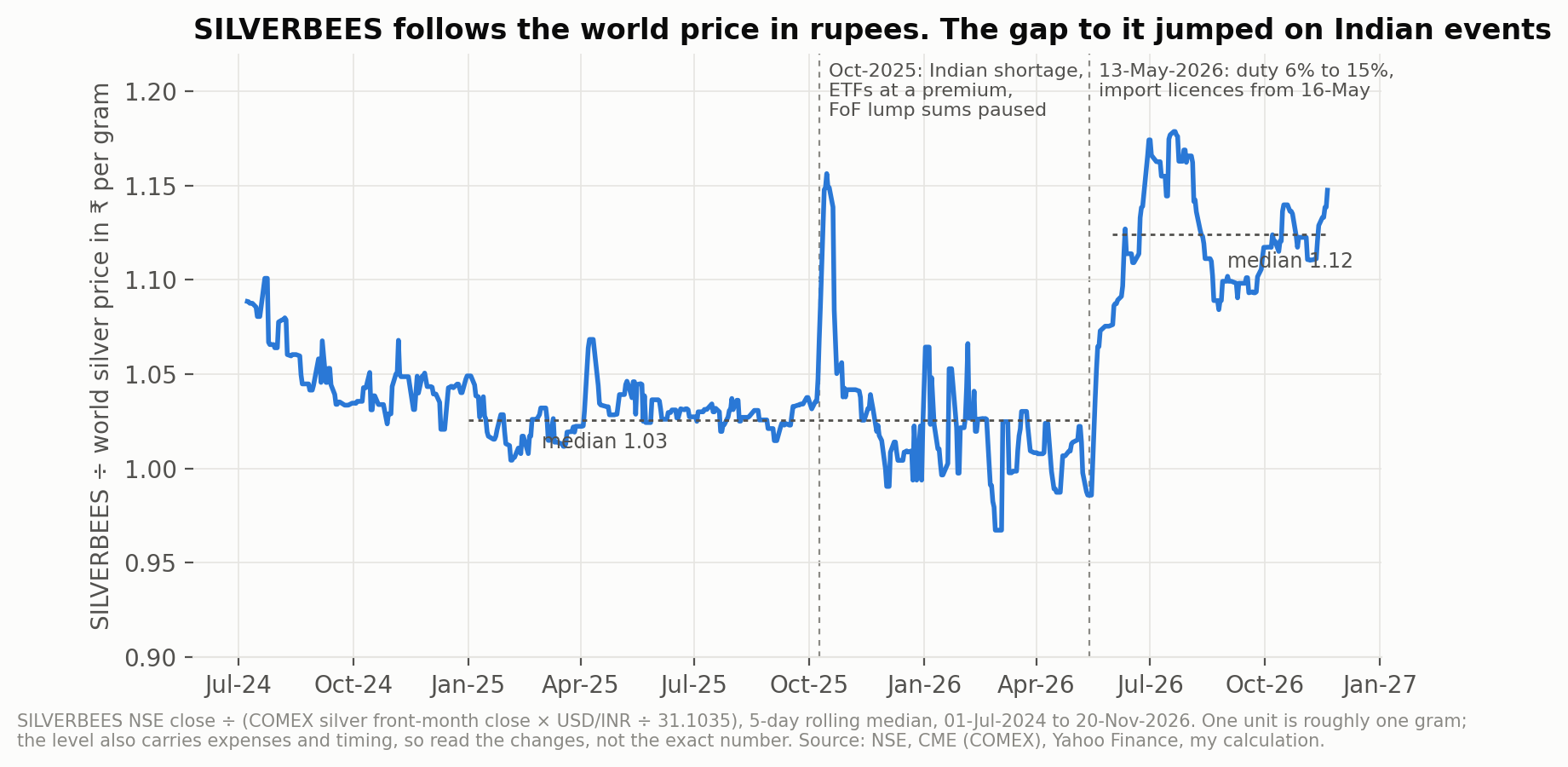
SILVERBEES close divided by (COMEX silver × USD/INR ÷ 31.1035), 5-day rolling median, 01-Jul-2024 to 20-Nov-2026. One unit is roughly one gram, so read the changes, not the exact level. Source: NSE, CME (COMEX), Yahoo Finance, my calculation.Look at October 2025. Ahead of Diwali, physical silver was tight in India. The line spiked and then came back down. UTI even paused fresh lump-sum investments into its silver fund of funds. Now look at May 2026. India raised the import duty on silver from 6% to 15%. The line moved up and tended to stay higher. The difference between the two is something a precious metal dealer would recognise immediately. The Diwali queue cleared. The higher duty was still payable on the next shipment. Reuters on the October shortage · RBI on the May duty change
You can see the same market through three different quotes. IBJA reports a domestic bullion benchmark. MCX quotes a futures contract for a particular delivery month. SILVERBEES is the exchange price of one ETF unit. Since April 2026, mutual funds value their physical silver using domestic spot prices polled by recognised exchanges. All three respond to a change in what silver costs here. They have different units and trading hours, so matching them tick for tick will only confuse matters. SEBI’s valuation circular
We have seen versions of this before
Those who invested during the March 2020 Covid panic will remember something very similar. When markets were hitting lower circuits, silver fell as hard as the Nifty.
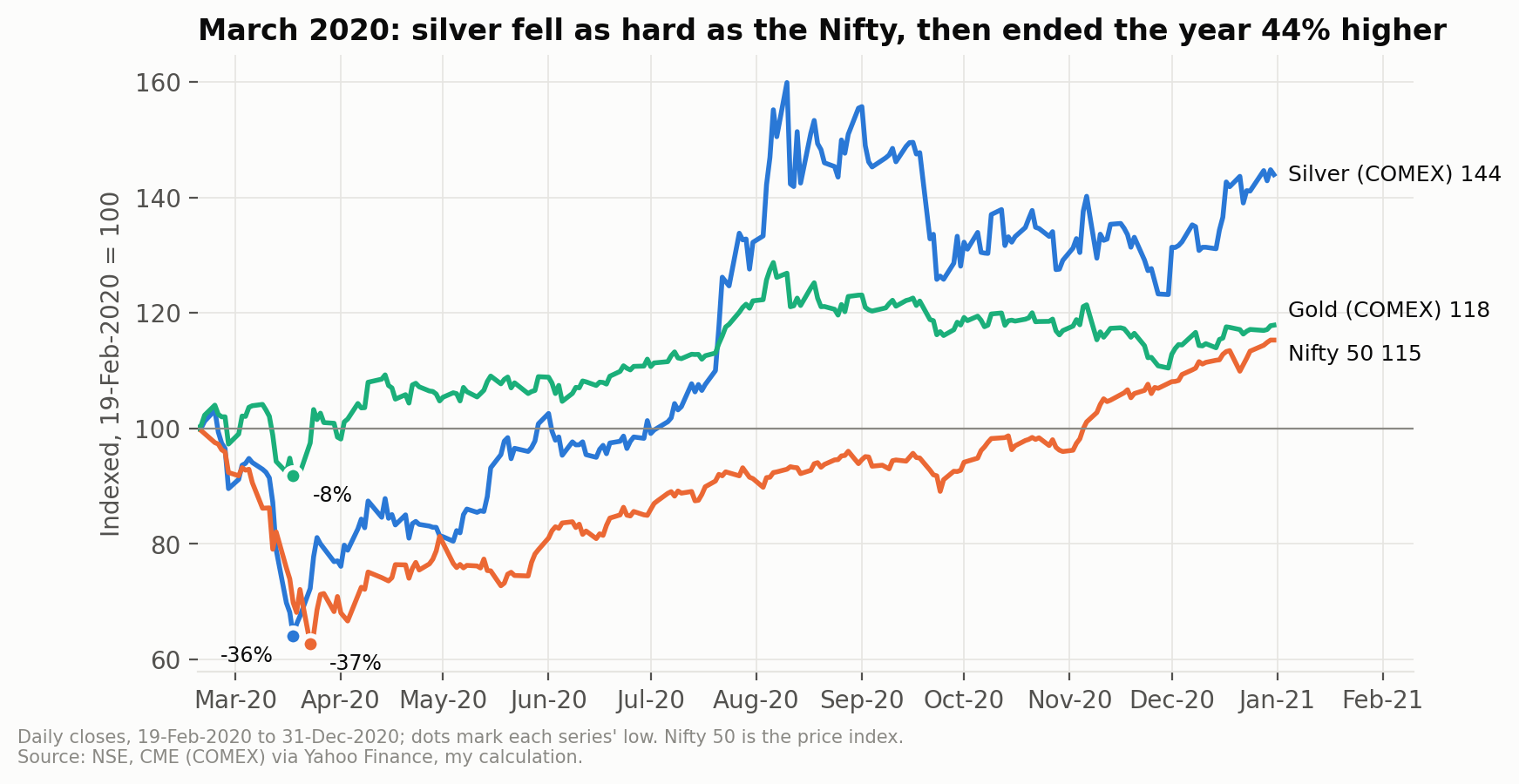
Daily closes, 19-Feb-2020 to 31-Dec-2020, indexed to 100. Nifty 50 is the price index. Source: NSE, CME (COMEX) via Yahoo Finance, my calculation.From 19 February to 18 March 2020, COMEX silver fell 36%. The Nifty fell 37% to its low on 23 March, while gold fell only 8%. Many investors were confused: isn't this metal supposed to protect us in a crisis? Big funds were selling whatever they could to meet margin calls. Meanwhile, if you walked into a local jeweller to buy silver coins, either shops were shut or dealers were charging a hefty premium over the screen price.
Silver did recover. It was back above its February level by July, and ended 2020 44% higher. I am not saying 2026 will repeat that. In its first few weeks, a fall driven by forced selling (AI hype unwinding and margin call pressure) looks the same on the screen as a fall driven by silver really losing its lustre. Only time will tell.
Three simple checks for Indian silver ETF and MF investors
- Check the iNAV before buying or selling an ETF. During sharp falls or sudden rallies, the market price of a silver ETF can move above or below the value of the silver inside it. Fund houses publish this live value, the iNAV, during market hours. Use limit orders rather than market orders, especially in the first 15 minutes after 9:15 am.
- Understand what drives your silver SIP in the short run. Over five or ten years, festival demand, solar panels and jewellery do matter. Over five weeks, your silver ETF moves with US interest rates, the US dollar and Wall Street's need for cash, including shocks in unrelated places like Nvidia.
- Separate a liquidity panic from a broken story. When leveraged traders elsewhere are raising cash, the fall can be sharp and uncomfortable, and nobody knows at what price the forced selling stops.
Should Indian silver investors worry?
There is no need to worry that Indian silver ETFs hold "paper silver." Under SEBI's rules, silver ETFs invest at least 95% of their assets in silver and silver-related instruments, and the metal is 99.9% pure, held with custodians and audited.
The volatility we are seeing is not a defect inside Indian mutual funds. It is how global commodity pricing works.
Whenever you read a headline saying physical silver is "sold out" while your ETF falls 20%, ask two simple questions.
-
Who is selling right now: a long-term owner of metal, or a leveraged trader raising cash?
-
And more importantly: does my allocation let me sit calmly while paper traders sort out their margin calls?
For chart readers and trend followers, price action and risk management come first. For long-term investors, it helps to keep precious metals a sensible share of the portfolio.
Happy to answer questions, or to hear how you are reading the silver charts.
Educational post on public information, not a recommendation to buy or sell any security. SILVERBEES is named for illustration only. Prices are from NSE, CME (COMEX) and Nasdaq via Yahoo Finance. Investment in securities market are subject to market risks, read all the related documents carefully before investing.