Two numbers help us understand what is happening in Index Futures: contracts and turnover.
Contracts tell us how many positions were traded, while turnover tells us the total value of those trades.
When both numbers fall, it generally means that trading activity is slowing down.That is what we see in the data for 2025 and 2026.
Index Futures are used by traders and institutions to take positions on the Nifty or Sensex, and also to hedge their existing portfolios. A significant part of the activity comes from professional, proprietary and computer-based traders, so changes in their participation can have a large impact on overall volumes.
The Downtrend in Activity
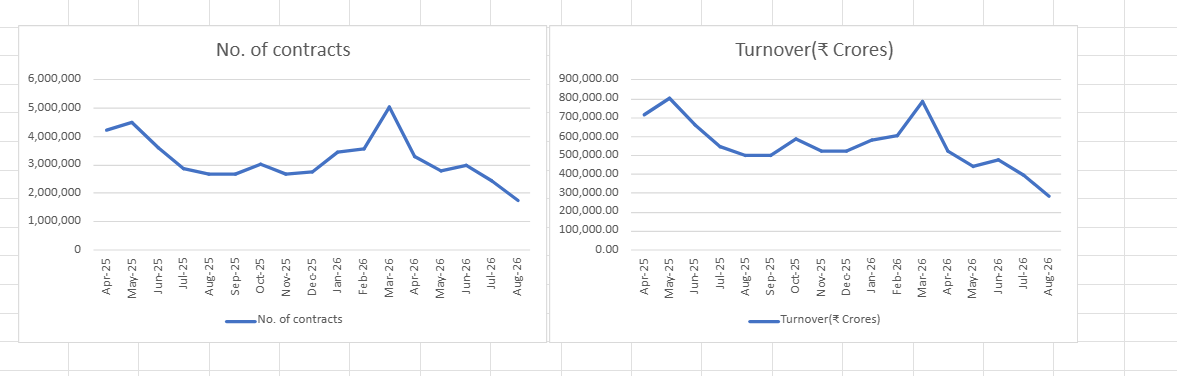
April and May 2025 were among the busiest months, with around 42–45 lakh contracts.
Activity then gradually declined and settled around the 26–30 lakh range during the second half of 2025.
The start of 2026 was somewhat stronger, with 34–35 lakh contracts in January and February.
Then March saw a sharp jump to 50.5 lakh contracts, the highest level in the entire period.
But it did not last.
By August 2026, contracts had fallen to 17.6 lakh, the lowest level in the data.
Turnover tells the same story. August 2026 recorded around ₹2.88 lakh crore, also the lowest in the period and well below the 2025 low of around ₹5 lakh crore.
So, August 2026 did not just see a fall from the March high. It went below the lowest levels seen during 2025.
Why Did March See Such High Activity?
March needs to be looked at differently.
The market was falling almost continuously through the month. Such a market usually brings higher volatility and more hedging activity.
Large investors can use Index Futures to protect their equity portfolios when the market falls. When the decline continues for several weeks, this can create a large number of futures trades.
That helps explain the 50.5 lakh contracts seen in March.
In April, the market stopped falling and started forming a base. As volatility and the need for urgent hedging reduced, futures activity also came down.
So March looks more like a market-condition-driven spike than the start of a new rising trend.
STT Added Another Pressure
From 1 April 2026, STT on futures increased from 0.02% to 0.05% of traded value.
The increase matters particularly for traders who make a large number of trades with small margins, such as arbitrage, high-frequency and proprietary traders.
There was also a decline in the share of proprietary trading in equity futures, from 32.7% in March to 28.3% in April.
But it would be too simple to say that STT alone caused the fall. The market had also moved from a sharp decline into a more stable phase, which naturally reduced some of the activity.
Then Came CAS
By July, tighter trading rules and funding conditions had added further pressure on some leveraged and proprietary participants.
Then, on 3 August 2026, the Closing Auction Session (CAS) started in the cash market.
The CAS runs from 3:15 PM to 3:35 PM, while Index Futures continue trading until 3:40 PM.
CAS does not directly change the futures market. Its impact can come indirectly through the cash market because futures, hedging and arbitrage strategies are closely linked to the underlying stocks.
Changes in closing liquidity and price-setting may lead some traders to square off earlier and reduce activity near the close.
Why August Was Different
August was the first full month after CAS began, but it was also a relatively quiet and range-bound month.
So several factors came together:
Higher STT + tighter rules and funding + changes in closing behaviour + low market volatility.
The result was the lowest Index Futures activity in the entire period:
17.6 lakh contracts and ₹2.88 lakh crore turnover.
It would therefore be too early to attribute the August decline to CAS alone. The fall appears to be the result of several factors working together.
The Takeaway
The bigger story is that Index Futures activity has gradually declined from the high levels seen in early 2025.
March 2026 was an exception, driven by a sharp market decline, higher volatility and increased hedging.
After that spike, activity continued to weaken and eventually fell below the lows seen in 2025.
The higher STT, tighter rules and funding conditions, changes in end-of-day behaviour and a quieter market have all contributed to this decline.